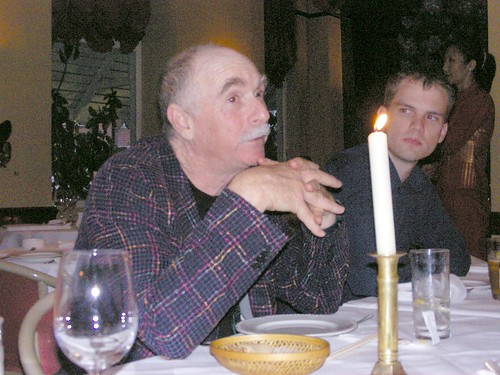
 I was at dinner with Howard Rheingold organised at the very last moment by Ian Forrester. It was a very good evening thoroughly enjoyed. But this post isn't about the actual dinner but a comment made by one of the attendees.
Discussion had turned to "The Daily Show" and "Colbert Report." Then the comment was made "I watch 'The Daily Show' but not the 'Colbert Report' as I am sure with my social network that if there is something really funny on the 'Colbert Report', I will find out about it" or words to that effect.
The comment shows an interesting trend in managing attention. People are using their social networks to expand the amount of attention they have. By relying on different parts of your social network to pay attention for interesting items effectively expands the amount of attention a user has.
What is the impact of this? I'm not sure as I haven't had the chance to fully think the implications through. Top of the head is that it will complicate the monetisation of attention. It also indicates that making very general social networks profitable will not be easy. The better route is adding social networking features around a series of more focused websites. Shades of the old Geocites and AngelFire?
The other side of the coin is that this is an interesting adaptation by an individual to managing information overload.
Tags:Attention, Social Networks, Geek Dinners
Monday, September 25, 2006
Social Networks and Attention

Thursday, September 21, 2006
Where have I been?
It has been a long time since I last posted. Several months in fact. Where have I been? Working. Of course this begs the question of what I have I been working that has stopped me blogging.
StrategyWire is what has stopped me blogging. I have been working hard getting the system up to scratch for the initial release, which has now come and gone. We (MarketClusters) are lucky to be in a position that we had paying clients with the initial release. Of course this creates the (good) problem of having to push further and faster with our development of the platform.
What is StrategyWire? Good question. StrategyWire is an online intelligence platform that organised news, blog posts, statistics etc. using a graphical map to allow users to easily understand their market. In many ways this will be the most interesting period because we will be building on a strong foundation adding in the whizz bang features. Of course we are looking to hire more developers (and analysts).
StrategyWire is part of the growing number of Enterprise 2.0 applications that are starting to appear.
Tags:Enterprise2.0, StrategyWire
Sunday, April 23, 2006
Australian Last Mile Broadband as a Utility
Debate has been raging (as much as debates rage in Australia) about who is going to pay for the next generation of broadband network and how they are going to pay for it. Telstra (the incumbent) has given the ultimatum that it will not build out a FTTN network without regulatory relief (translated: we want to charge monopolistic prices to competitors to access the network). Their reasoning is the requirement to achieving a realistic return on investment.
Last week Telstra's main competitors tossed a curve ball by offering to jointly fund the build out of a FTTN network for Australia in exchange for access. Which of course nails Telstra's ROI argument.
What I find most interesting in this debate (many do expect that the offer as proposed will get off the ground) is the airing of different methods to developing out next generation broadband networks. The common element is the recognition that the base network is a utility. The proposal for joint funding recognises this.
While it is debateable that joint funding will work (it may) it opens up the debate to other methods of funding. One that needs consideration is the to place the last mile network (exchange to doorstep) into a tradeable asset trust. The trust would own the network and service providers would purchase access from the trust. The advantage of the trust is that it separates network provision from the service provision (a utility) and provides a level playing field for service providers. The network asset trust would also provide a long term investment vehicle for pension and super funds.
Last mile access is a utility and the joint funding proposal is a clear indication of this fact. Last mile access as a utility casts the net neutrality debate a completely different light and negates many of the arguments put forward by the US bells.
Technorati Tags: Telstra, Broadband, Optus, Utility, Net Neutrality, FTTN
Technorati Tags: Telstra, Broadband, Optus, Utility, Net Neutrality, FTTN
Microsoft's Choice
Google and Apple have shifted the competitive landscape leaving Microsoft fighting a defensive battle on a battlefield not of its choosing. Microsoft faces the dilemena of continuing to compete on their competitors terms or disrupt the competitive landscape.
The first choice will lead to the slow but inexorable decline in revenue and profitability of Microsoft. The second choice is very risky because the outcome is unknown and will involve the internal disruption of Microsoft. Two stark choices but only one can halt the decline of Microsoft.
So what can Microsoft do if it chooses to go with the second option? Microsoft needs to swap the Win32 kernal for the Linux or BSD and focus on the UI and productivity aspects of the OS. Similar to Apple's strategy with OS X.
By using a Linux or BSD kernal Microsoft benefits in several ways. Fundamental architectural decisions made a long time ago are placing constraints on how secure the WinOS can be made. Security is becoming increasingly important and is now effecting choices on OS. A Linux/BSD kernal provides the fundamental security necessary to build a safe OS. Using a Linux/BSD kernal will allow Microsoft to concentrate on the UI and productivity aspects of the OS which fits very neatly into the creation of a seamless computing experience that Microsoft is pursuing. It reduces OS maintence and development costs. Microsoft essentially outsources the bug fixing and OS maintence to the Linux or BSD community. Microsoft would still need to participate but would not need to devote so much resources on housekeeping but can focus on innovation.
Using a Linux or BSD kernal will allow Microsoft to increase margin on the OS product while reducing the cost to the consumer. A benefit that Microsoft's hardware partners will appreciate.
Those are the direct internal effects of this move. But there will also be disruptive market effects of a kernal switch, which can be argued to be far more important to Microsoft.
- The sea anchor of being an OS company that is stopping Microsoft competing effectively in the new market.
- It will in on fell swoop take the wind out of most of the anti-trust suits that Microsoft currently faces.
- The OS versus OS argument looses bight as it becomes an argument about Unix flavours.
- Security and productivity reasons for swapping OSes (ie from Win to OSX or Linux) will be mutted if not completely sunk.
The question remains of what kernal would Microsoft use. Technically there isn't much difference between Linux or BSD kernals. I expect that Microsoft will go with the Linux kernal for the following reasons:
- Linux already has a greater amount of public mindshare and it would allow Microsoft to reclaim those organisations that have already move to Linux Desktops,
- Linux developer community is larger (and more vocal) than the BSD community, and
- Steve Jobs choose BSD.
Technorati Tags: Microsoft, Disruption, Strategy, Linux, BSD, Apple, Google, OS
Monday, March 27, 2006
The Undiscovered Pearl of the Blacksea
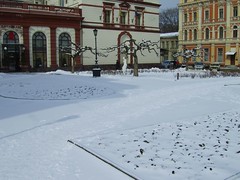
Another distinct feature of the city is the huge number of sculptures and statues dotted around the city. Many are beautiful and well worth a look.

While I was there during the winter, it struck me wandering around Odessa that it would be a lovely city to visit during the summer. Particularly with the beaches a 5 minutes walk from the centre of the city (where the decent hotels are :) ). A traveller can spend the day lazing around on the beaches and then hit the many good pubs or clubs at night. After dinner at one of the resturants that serve great food. Of course there are a number of museums to satisfy intellectual guilt before heading back to the beach and niteclubs.
But and there is always a but, travel to Odessa is not for the package holiday maker. Odessa (at tis time) lacks the developed tourism infrastructure that Malaga or Ibiza have. Odessa is really for the independent traveller at this time or those looking for a holiday that is slightly different but still has niteclubs and beaches.
If you do make it to Odessa, drop in to Mick O'Neils Irish Pub. A good pub, a great atmosphere, good food and drink. O'Neils also doubles as the local for the expatriate community of Odessa (all six of them :). Speaking of which I would like to thank Steven, Debbie, Mark and Alan for their selfless inclusion of a traveller into their circle if only for a short period. Special thanks to Mark for taking the time to show me some of Odessa.
I enjoyed my trip to Odessa. I hope I can find the time to return in summer. I do recommend a visit with the proviso that is still rough and not for your average package tourist. But if you want a holiday that is different, not overly touristic then a trip to Odessa could be what you are looking for.
Doing a Hugh in Italian
The Italian textile and footware industry simply can't compete in mass market production. If it is not China it will be Vietnam or Burma or Cambodia or Africa. There will always be someone with cheaper labour. Trying to compete directly with the cheap labour is not going to work. Instead the Italian textile industry needs to build on their unique characteristics. The Italian textile and footware industry has a history and a reputation that the cheap labour countries cannot replicate. Taking advantage of their history and reputation is how the Italian companies are going to be able to compete.
Italian textile and footware companies need to create global microbrands that use the reputation and history as a foundation. The global microbrands are important as they create the demand for the time of the craftsman. Time is the only scarcity. But scarcity has no intrinsict value. Value only comes from the interaction of demand and scarcity. Here lies the success of English Cut (doing a Hugh). Through creating a global microbrand English Cut created demand for the time of the craftsman.
There is no reason why Italian textile and footware companies cannot create their own global microbrands to sell the time of italian mastercraftsman. They need to do a Hugh.
Links:
Hugh Macleod's The Hughtrain Manifesto
Technorati Tags: Hugh Macleod, Global Microbrand
Sunday, February 19, 2006
Discovery of A-List Posts: Or Why A-lister vs Z-lister debate is a red herring
The conversation that started about gatekeepers has moved on to about A-listers vs Z-listers. Or how Z-listers can become A-listers. You can see the part of the conversation here on tech.memeorandum.
If you are trying to be an A-lister you aren't. Now matter how hard you try it just ain't going to work.
Besides the point isn't to be an A-lister but to write A-list posts. To do this you need an interesting topic, something worth saying (I agree posts get tired very, very quickly) and a readable style of writing. Note carefully that last point. Readable style of writing. I have lost count of the number of times I stopped reading a post after the first paragraph because of really bad writing (I'm looking at you Umair Haque of Bubblegeneration). I enjoy reading Gapingvoid because of Hugh MacLeod's writing style (not to mention the cartoons). It is really simple concept. I With the amount I read every day I don't have time to waste deciphering incomprehensible writing.
Back to the A-lister vs Z-lister debate. The real issue is allowing A-list blog posts rise to the surface from whatever blog they are posted on. Robert Scoble and Om Malik don't write A-list posts all the time. The blogsphere will improve if we make the shift away from thinking in terms of blogs to thinking in terms of posts.
More is needed to help good posts to rise to the surface. Technorati has just implemented their "Authority" slider. However, this still looks at the whole blog and not the individual posts. This is a step in the right direction but the slider could do with refinement to look at per post authority. The other major problem with Technorati's "Authority" measure is that it counts links. This fails to account for the "virtual bloggers" who simply read the post and may leave a comment but do not have their own blog.
There is never going to be a magic bullet for finding good posts. What is needed is a series of measures to rate and compare posts. Some of these measures will be social/community based. Others will be algorithmic like Google News. The more methods for quantifying quality the greater the likelihood of a good post finding its way to the surface where ever its location.
To kick start the debate I propose that two widgets be included in blogs. These widgets would allow readers to rate a particular post. One widget would allow the reader to rate the quality of writing and the other widget would let the reader rate the content i.e. is it interesting, funny, flamebait etc. Think of it as the Slashdot moderation system write large across the blogsphere. The same system can be used for comments as well.
The rating widgets fall into the community/social category of rating measures. What is now needed is a algorithmic measures. Bayesian filters fit nicely. Bayesian filters can be used to find good posts across the blogsphere in much the same manner as they detect and junk spam. The filter would compare each individual post against what it has learned are good posts. The filter can be continuously trained by simple yes/no button for readers and by tying the rating widgets.
Over time further measures can be added including rating the readability of the English and creating topic specific Bayesian filters (what is considered a good post of skateboarding may be quite different from what is considered a good post on 19th century Russian Literature).
No system will ever be perfect and the system will need to be continuously refined. A combination of social and algorithmic methods will be needed to discovery good posts. Neither social or algorithmic alone can do it. And if you are a Z-lister wanting to be an A-lister, writing consistently good posts is the fastest way to becoming an A-lister. Whinging about being a Z-lister is not.
Technorati Tags: blogs, attention, blogging, brreeeport, a-lister, z-lister
Saturday, February 11, 2006
Rocketboom and Attention
This week news broke of Rocketboom auctioning ad space. Jeff Jarvis has a post quoting Henry Copeland's view of the Rocketboom auction. It is easy to exaggerate the importance of this auction but I see this as being an interesting harbinger of things to come. It also speaks to a weakness of Google.
What is developing is a transparent market for the sale and purchase of attention; an Attention Market. Just like Fred Wilson wanted. The market poses a serious issue for Google maintaining the growth in revenue. It dent's Google's strategy of becoming an attention arbitrator. Google's current strategy seems to broaden the size of their attention pool through foray's into main stream media. I see this providing a short term to medium growth in revenue but this will rapidly become difficult to maintain as the Attention Market's momentum grows.
Google is not the only company threatened by the Attention Market. All of the Internet Ad Networks and traditional advertising arbitrators will be challenged and changed by the Attention Market. While the Attention Market threatens the established order it brings new opportunities for investment and companies.
Technorati Tags: attention, rocketboom, attention market, google
Monday, February 06, 2006
Disrupting the VC Industry Redux: Disrupting Equity Financing
The simple fact is that VCs are not going away. No matter how hard some people might wish. VCs bring value to the table. However, the value that VCs bring does not fit every situation. VCs are currently used as a one-size-fits-all solution to problems. This is where the VC or, more accurately, the equity financing industry will be disrupted. Disruption will come from solutions that address particular problems or situations within the equity financing industry.
In my previous post on this subject I proposed a VC marketplace as one solution. I foresee this market covering the early stages of new company/idea development. From conception to a product with a few customers and some revenue. Put in web service terms, this would be from conception to the beta with a few customers and some revenue coming in. It is from this point that VCs add value. The marketplace, while it could still be used, is not necessarily the best solution for further equity financing. VCs can help smooth the ride as the company goes through major growth spurt. The aim of VCs should be to help the companies leap the "hole".
The VC markeplace doesn't replace VCs. The VC marketplace compliments VCs. The marketplace provides equity financing to companies to get them to the point of being ready for VC funding if they so desire.
Does the investment company proposed by Dave Winer and seconded by Doc Searls have a place. Many bloggers don't think so. They point to the previous failure of publicly traded VC funds. As proposed, I agree. It really isn't a particularly good idea nor is it disruptive (no matter how you cut it) as stated. For its proposed vision it well..sucks. However, the company does have a place within the equity financing industry. Just not the one dreamt of by Dave et al.
The fund could be useful for providing cash injections into companies that either don't want to undertake a round of VC funding (remembering Guy Kawasaki's refrain "To much money is just as bad as to little") or don't wont to involve VCs in the company for some reason (they see the VCs as the devil in disguise). The fund is another way of raising equity financing when VCs or the marketplace aren't a suitable solution.
The fund would only address companyies with cashflow that have an equity requirement that is too small to be worthwhile for VC funding (which seems to be as high as US$10m at the moment and likely to go higher). The fund would focus on purchsing preferred stock as opposed to common stock. Which translates (very roughly) as purchasing a slice of future profits as opposed to a slice of the company
Technorati Tags: VC, disruption, vc disruption, markets
Sunday, January 29, 2006
Disrupting the VC Industry: a VC investment Market
A more disruptive idea is to create a VC market. A market where people (users included) can invest in high risk/high growth businesses from an early stage. A market for Venture Capital would be far more disruptive than simply creating another form of the VC.
So how would the market work? A company would register with the market. The registration process would include the necessary due dilligence process that provides the basis for trust within the market. The company would then place a certain number of shares up for auction.
The auction process would work like this. Bidders bid not only a price but also an amount of shares they wish to buy at that price. At the close of the auction, the highest bidder pays the amount they bid and receives the corresponding number of shares that they bid for. If the highest bidder did not buy all the shares then the remain shares are offered at the final bid price to the other bidders.
An option is available where the total amount of a final bid (bid price for shares x the number of shares wanted) of losing bidders will be divided by wining bid price and they receive that number of shares. The shares that people purchase can then be traded within the market. The last traded price for a company's shares becomes the starting price if a company decides to do another round of funding.
Anyone can register to bid. The registration process for bidders is again a due dillegence process that provides the bid side trust for the market. There is no minium amount or number of shares that a registered bidder can bid for. If all they want is one share , then that is all the need to bid for.
A VC investment market opens up investment in high risk/high growth to anyone (Doc Searls and Dave Winer's users) businesses. A far greater number of businesses will be able to seek and receive VC funding than through the current method. The risk of any individual investor can be spread even further. It also brings competitive bidding to the process which will bring their own improvements to VC investment. Finally, it opens VC investment to the wisdom of the crowds which brings with it the possibility of better selection of great ideas.
I really think that a VC market will produce far greater disruption of the VC investment industry than the creation of a publicly traded VC fund as Dave Winer has proposed.
Links to Conversation:
Michael Parekh, Paul Kedrosky, Mathew Ingram, Michael Arrington, Mark Evans, Robert Scoble
Technorati Tags: VC, Venture Capital, Markets, Disruption, Doc Searls, Dave Winer
Healthcare and Education Spending
[Ed note: I wrote the post a while ago
but I never got round to posting it. After reading two articles
in the Economist, I was motivated to post it. Although it is
about Australian education and healthcare it is applicable to other
countries.]
Spending on healthcare and education is tied in
with poverty traps, reforming the tax system and welfare.
Currently, Australia has a complicated system that creates poverty
traps as benefits are means tested, disrupts the effective delivery
of services and complicates the tax system even further.
Reforming the way education and healthcare are paid for will
make significant in-roads to improving these community services.
This isn't about who should paid which has largely been settled in
favour a joint payment by both the individual and the state.
Rather it is about how the state money is provided to fund the
services.
Education and healthcare are currently funded in a
top down approach. The money slowly trickles down until
eventually some very small amount reaches the front-line where the
service is actually delivered. The money gets eaten up by
salary increases, administration expenses and pet projects.
This all leads to waste and increased costs in delivering the
service.
The funding needs to injected into the bottom, at the
point of service delivery. The funding is then delivered to
where it is needed by those who need the service. It also
brings in the possibility of competition as service providers now
half to provide a service that the consumer wants to use.
The
best way to inject the funding at the point of delivery is to create
non-means tested education and health accounts. The federal
government recurring spending would go into each person's education
and health accounts to be spent as the individual determines.
The
accounts would come with a left and right of arc. An education
account can only be spent on providing education and health accounts
only on health. The health accounts would have further
restrictions on the type of health services it can be spent on i.e.
most cosmetic surgery would be out. If you want that save up
and pay for it yourself. If the individual chooses services
that cost more than what is placed into the accounts yearly then the
individual has to pay the difference. For example, you send
your child to the most expensive private school then you will need to
pay the difference between what the account provides and what the
school charges.
The accounts would replace most if not all the
federal funding of health and education. The introduction of
the accounts would see any restrictions on price and price caps
removed. This will introduce price signals into the delivery of
the services and increasing the scope of competition in the delivery
of services. In this time of population movement, travelling
and globalisation the money in the accounts can be spend with
overseas providers of healthcare and education.
To
ensure the functioning of the accounts a minimum capitalisation of
the accounts will be mandatory. Just as financial institutions
are required to do. Continuing the theme of choice, the
individual will have the choice of who manages the accounts: their
bank or building society, insurance organisation or the RBA for the
government.
The health and education accounts strike a balance
between effective delivery and competition in service delivery while
ensuring a fair level of access to these services for all
Australians. The accounts also empowers Australians to take
responsibility and control of their lives. These accounts take
what is best of the Canadian, UK public funded systems with the best
of the US funding at point of delivery.
Technorati Tags: Australia, Policy, Education, Healthcare
Saturday, January 21, 2006
Digital Media Marketplaces
One question that has bugged me is how would a marketplace determine the value of digital media. The pricing mechanism lies at the heart of any marketplace. For the marketplace to function properly the market needs to method to effectively set the value (and consequently price) of digital media. If the pricing mechanism is faulty then the market wont operate smoothly.
Stockmarkets prices are set by the interaction of the amount of a company's shares available for sale and the demand for the shares. The price is primarily determined by the scarcity of supply. Digital media doesn't have a finite supply. It has an inifinite supply of perfect copies. Scarcity of supply is not going to work in a digital media market as a pricing mechanism.
The Logistics Equation could be used to provide "pricing" variability that is determined by the market. Not really a very good system. Artifical constraints are placed on the market and prices only go up and never down. Not really a dynamic market with variable pricing.
A better pricing mechanism is to use demand per unit time. The price is then determined by the scarcity of demand. As the demand per unit time goes up the price rises, as the demand per unit time goes down the price falls. The beauty of this system is that the price is set by the operation of the market. It also produces a dynamic market with variable pricing with little or not artifical constraints.
Technorati Tags: digitalmedia, markets
Technorati Tags: digitalmedia, markets
Tuesday, January 17, 2006
Net Neutrality and IPTV
As I see the primary driving force between the Telcos/Cable Companies (shall they become the new Evil Empire?) is to make their wonderful, investor friendly IPTV plans economical. As I have discussed in a previous post IPTV has significant disadvantages to Broadband TV to the point of IPTV being uneconomical when competing against Broadband TV. Unless the Evil Empire (aka telco/cable companies) can implement two tiered Internet.
The telcos/cable companies are frantically seeking to raise revenue and ARPU (the CEO's bonuses depend on it remember?) in the face of the on-slaught of the IP world. They see IPTV as their salvation and are consequently desperate to make their IPTV plans work. Unfortunetly, Broadband TV makes destroys the economics of their plans. The only way to make IPTV economical is to make it impossible for Broadband TV to be delivered at reasonable resolution and speed (downgrading Broadband TV packets or tiered Internet) without paying. The price the Broadband TV provider has to pay would at the very least make the IPTV competitive but more likely be set to price Broadband TV out of the market (wouldn't want to compete, now would we?)
Technorati Tags: NetNeutrality, IPTV, BroadbandTV
Technorati Tags: NetNeutrality, IPTV, BroadbandTV
Sunday, January 15, 2006
Strategy of Microsft and Apple
How they pursuing this empowerment differs. Microsoft's strategy is to create seemless connectivity between all the devices at the edge of the network in order for users to be more productive. While Microsoft sees a growing importance for other devices, they still see the PC remaining an important part of the edge of the network. Why centeralise the PC's functions when you are trying to push power to the edge? No thin clients for them.
Apple's strategy differs as they are pursuing a strategy of seemless creation, publishing and distribution of content at the edge of the network. Their focus is less on productivity and more on creativity. Again the idea is to push as much power and functionality to the edge of the network, not to centeralise it.
Both Apple and Microsoft see the edge of the network as becoming the dominate paradigm for the future. Centeralise services and products will still exist but only as the support or compliment edge services and products. A good example is Steve Jobs' demonstration of Photocasting. All the creativity was done on the iMac and distribution was accomplished by a RSS feed mediated across .Mac. The centeralised service, .Mac, support the creativity by providing the user the means to distribute their creativity. Expect to see the same for music and video through iTunes and .Mac in the future.
Noteworthy, is that both strategies of the companies are not mutually exculsive. Both strategies while competing are still complementary. How Microsoft and Apple manage the competitive/coperative relationship between the two companies will be interesting.
THe keynote addresses signaled a shift to the edge of the network. They also signalled that both the telco industry and content industries are now facing two companies that thrive on rapid innovation. Few companies in these industries are up to the pace of change. Perhaps even more worringly for the telcos and content companies is the shift in power balance to Microsoft and Apple.
Links: Steve Jobs' Keynote Address
Bill Gates' Keynote Address
Technorati Tags: Apple, Microsoft, Strategy, Edge, Keynote
Technorati Tags: Apple, Microsoft, Strategy, Edge, Keynote
Saturday, January 07, 2006
Variable Pricing on iTMS
The Labels are demanding that Apple loosen the reins and allow variable music pricing. And there are sound economic reasons for this to happen. Others in the blogsphere have explained the reasoning behind variable pricing in more detailed than I will go here. The labels though, want variable pricing which would put new releases at a price well above what is currently charged.
I personally find this hard to justify. To me it smacks of monopolistic pricing brought on by a lack of competition and waste in the labels operations. But back to the case of variable pricing.
EMI's boss has publicly stated that he expects Apple to institute variable pricing. Many bloggers expect Apple will expect implement variable pricing. Elliot Spitzer's investigation of the US music industry could easily force greater price competition.
So will Apple implement variable pricing? Quite likely. It was bound to happen and Apple will need to maintain "freshness" in the service or risk losing large numbers of users to other download stores. Already this is happening.
But Apple isn't likely to give the Label's exactly what they want. They will implement variable pricing but the upper price is going to be 99 cents. That will be the maximum price and prices for songs will descend from there.
Tags: Apple, iTunes, iTMS, Bubblegeneration, music
Thursday, January 05, 2006
Paying for Fibre Networks
Governments can fund the roll out of fibre last mile systems. This is what Amsterdam City council has decide to do. But government funding is not the only means for funding fibre last mile network rollout outside of a large telecommunications company paying for fibre rollout.
The fibre last mile network is an asset with a relatively predicatable income stream. Funding a rollout can be done by creating an income or royalty trust that will own the last mile network. Investors would buy units in the trust and this money would be used to fund the rollout of the fibre. The trust would not lay the fibre themselves but pay a third party company (or companies) to do the construction work. Once the network is rolled out then the trust simply charges telecommunications providers for access to their last mile connection. All telecommunications operators then have equal opportunity for network access.
Using Income/Royalty Trusts to fund fibre rollout has several advantages. Governments don't need to get involved in funding the rollout nor providing regulation to provide equal access to an incumbents network (always a messy business). A single company is not burdened with a very large capital expenditure over a long period of time. The trusts would soak up a lot of the cash that is sloshing endless around the planet causing various problems. The trusts would also create a "steady" income stream for long term investment. I expect that the trusts would sit between bonds and equity in the risk/reward metric. This would provide the pension/super funds with third security for parking cash.
But the main advantage is that the trusts would see last mile fibre networks rolled out now rather than possibly maybe sometime in the future.
Tags: FFTH, FTTN, Telstra, Funding, Telecoms, Last mile, Broadband, Internet, Fiber Optics, Trusts
Sunday, January 01, 2006
Predictions for 2006
As the new year starts, I thought I would jump on the bandwagon of "Predictions for 2006". In no particular order:
Wireless Internet will move mainstream. The Wild Wild Web will move onto the screens of mobile phones as it has already done with PCs. As the Wild Web takes over the screens of the mobile users the precious walled gardens of operators will die. The manicured lawns and delicate pansies of the flower beds succumb to the voracious growth of the Wild Web. This will open up hundreds of new opportunities and services to mobile users. It will further erode the boundaries between wired and wireless spheres.
The Attention Wars will begin in earnest. All though the first shots where fired in 2005, full scale battles will begin in 2006.
Web service operations will suffer. Web Service companies will face outages and problematic quality of service through out 2006 as these companies learn the hard way about operations. While individual companies will improve overall there isn't going to be drastic improvement in the quality of service of web services. It is likely that web service operations will see a increase in the use of Big Iron to do the heavy lifting and mission critical tasks leaving the server farms to serve pages.
Usability will become a competitive differentiator for services and applications. Apple has demonstrated (again) the power of usability. Other companies are going to seek to harness that power in differentiating their service or application in the crowded marketplace of the Internet. Getting the mix between features and usability right is going to give a company a strong competitive advantage. An obvious example is the metaphoric revolution that Office 12 is going to usher in.
Digital home entertainment will enter new phase. The roll out of Media Centres will pit companies molded and shaped by relentless competition against oligarchs shaped by monopoly agreements and captive audiences. Competition for the attention of audiences will become far more intense as Internet video moves from being an indirect threat to a direct threat to broadcasters.
Identity 2.0 will become the catch cry of 2006. The possibilities opened by what has been termed Identity 2.0 from attributing comments and posts across the blogsphere to banking to fighting fraud and e-crime will bring this squarely into the centre of attention of the Wild Web. But like its counterpart in the offline world, identity 2.0 is only going to be as strong as its weakest link. Which is usually the process and documentation for obtaining an id card. This is the problem of a "real id" obtained using fraudulent means. For example using someone else's birth certificate to get a driving license. This will need to be addressed as Identity 2.0 is rolled out across the web.
Broadband TV will continue to gain momentum at the expense of the telco's TV offerings. Broadband TV will continue to grow as experimental broadcasters, non-traditional broadcasters and content owners push more and more video to the consumer through the Internet. The lower cost broadband TV solutions will erode the economic viability of the telco's TV offerings. Something that many telcos seem aware of given their recent rantings on two tier Internet. Two tier Internet will have a much greater effect on Broadband TV than VoIP or Web Services.
Uplink speeds will become a competitive point as ISPs struggle for differentiation in the Speed Wars. As the download speeds escalate rapidly it will become harder and harder for ISPs to differentiate themselves on speed and for the smaller ISPs to remain in the game. At the same time the speed claims will face greater scrutinity from consumers and regulators. This will force ISPs to find alternative ways to differentiate themselves which they will do with uplink speeds. We won't see a sales pitch based on synchronous speeds but something like a 8-12 Mbps downlink with a 1-4 Mbps uplink.
Tags: Predictions, Web Services, Broadband TV, Wireless, Media Center, broadband, Identity 2.0, usability
Tuesday, December 27, 2005
Threading conversations
Recent posts have talked about the mining the information contained in comments on blogs. The bigger issue to me is threading the whole conversation that is scattered across the blogsphere. Of which comments are a part. Trying to follow a conversation let alone the comments is, shall we say, difficult? More accurately it is tiresome and bordering on impossible in many cases.
Of course the aggregators and search engines can do a manual method. This will lead to missed posts and more importantly likely to miss the part of conversation held in the comments. Instead we need a system of automatically threading conversations ala Thunderbird or Outlook.
Until now RSS has been limited by being one way. Add in SSE and now conversations can be synchronised across sites. Instead of having a trackback or backlink each post would have a thread feed. When another blogger adds a post to the conversation they use the thread feed instead of the trackback. The post shows up on both sites with comments. Now the conversation is threaded. From any one blog the reader can find the whole conversation and not have to ferret it out across the general blogsphere.
Together RSS and SSE provide the active feedback channel that Zoli Erdos wants. It provides the automatic threading of conversations (including the comments) across blogs. Perhaps not the most elegant method but it is simple and can be done now and I'll take simple and avaliable over perfect and unavailable anyday.
Tags: blogs, conversations, RSS, SSE, tracking, feed, weblog, RSS+SSE
Monday, December 26, 2005
Thursday, December 22, 2005
Reliability and Liability
37signals posted on why relability wasn't critical for web service companies on the 6 Dec 2005 . Two weeks later several web service companies, SixApart, Del.icio.us and even the granddaddy, SFdc, had outages. Bloglines service has been spotty. The frustration that these failures have caused is evident from the moaning across the blogsphere. The SFdc failure has caused businesses to loose money.
Reliability matters in operations. Even for web service companies.
But debates on reliability are clouded by misconception and misunderstanding. We need to understand why reliability numbers can be misleading and how reliability is achieved.
Reliability as a Number
Reliability is often specified by a wonderful percentage: 98...99...99.9...99.98 and so on but what does the number say and what doesn't it say. Reliability in its simplest form is how many hours within 100 that the service is not available. Therefore 99% means 1 hour in every 100 the system is unavailable. The number does not tell you is how that hour is spread out across the 100.
What reliability numbers do not tell is how that 1 hour in 100 came about. The quality of the reliability. Two scenarios. Every 50 hours the system is take down for 30 minutes for preventitive maintence. The time is scheduled and announced well in advanced. Or that 1 hour is randomly spread across the 100 hours from failures and random firefighting. Users receive no warning of the outtages and they can come at any time.
The first scenario is a lot less fustrating to users than the second and yet they have the same reliability number. Reliability specified as a number is next to useless and can be grossly misleading. Before you can use a reliability number you have to understand how it occured. You need to understand the quality of the operations overall.
Achieving Reliability
There are two methods to achieving reliability: the brute force method and the smart method.
Using the brute force method to acheiving reliability is expensive. Each extra step in reliability is more expensive than the next. Each step increases the complexity of the overall system. Which of course increases the risk of something going wrong. To make matters worse not only does the risk of failure go up, the risk of a spiral into catastrophe also increases. Not a nice combination.
The brute force method is often used as it is easy to understand. But for many web service companies is overkill and too expensive.
The smart method is routed in engineering risk analysis: identifying the types of failure, the probability of failure and the consequence of failure. The various failures are ranked by risk: a combination of the probability of failure and consequence of failure. These failures can then be dealt with from the riskiest to the least risky.
Risk analysis reduces the cost of reliability by giving the users an objective method for identifying where they will get the biggest bang for their buck. But it is a continual process. It is not something that you do once, place into a drawer and forget about. The risk analysis must be done continuously as the risks and likelihood change as the environment, technology and business evolve.
There is going to be a lot of resistance to using risk analysis techniques in web services companies. If nothing else simply because it challenges the current way of doing business. But for the web service companies to survive they are going to have to embrance and internalise engineering risk management.
Risk management techniques were developed to address liability issues that engineering firms faced. They were hard lessons but liability force the engineering companies to develop better operations. Perhaps it is time for the web service companies to be liable for the quality of their service.
Tags: 37signals, reliability, webservices, risk management, quality, engineering operations, sixapart, salesforce.com, del.icio.us